FOUNDING COHORT · TPA · 01 · ENROLLMENT OPEN21 JUL → 22 SEP 2026 · 9 WEEKS

You tell people you’re not technical.You’re lying to yourself.

You use AI every day. You’re getting good at it. You know what’s possible. You suspect you’re using maybe five percent of what’s possible.

You’re spending time on things you know you could automate. The idea dies in the gap between “I should learn” and “where do I even start.”

You’re paying $200+/month for tools you suspect you could build yourself if you knew how.

The suspicion has started to sting.

9 weeks3 systems you own15 seats→ founding cohort
Hold your seat →
02 The costPG · 02 · LEDGER · REV. A · 21 JUL 2026

What that lie is costing you right now.

There isn’t time tomorrow for this. AI is moving at the speed of light. The coworker who figured out how to make it work for her is outshipping you. The guy you don’t like is using it to plan the next two moves of his career.

You’re on the sideline. The sideline is moving backwards.

A · What it’s costing you
B · What you’d own
01
Hours of mindless email every morning
— hours/week · paid in attention
An agent that runs your inbox before breakfast.
→ R-08 · email automation
02
$200+/month in SaaS you suspect you could replace
— Quicken · Rocket Money · YNAB · etc.
A financial system that runs on your machine, owned by you.
→ R-07 · saves Alexander ~$200/mo
03
A someday list two years deep
— ideas · paid in regret
Three of those ideas, shipped, in your hands by week 9.
→ MCP + recipe + your own
04
Bracing in every conversation about technology
I’m more of an analog person
A different posture when the topic comes up.
→ the felt-sense shift
Σ
Total · running cost
Total · what you’d own

You’re not analog. You’re scared. Fear of technology is a shadow, like fear of money. The internet is a new fire. Humanity is burning and getting burned already.

Pick up the fire.

PG · 02 · INTERLUDEREV. A

The model writes the code. You design the system.

Something changed in the last 8 months.

AI tools have moved the cost of development to near zero. The model writes the code. You design the system.

For fifty years, software was gated by people who could write it. That gate is gone. What’s left is design and ownership.

The future is bespoke personal systems — on your computer, in your cloud, on your devices. Customized for your life. Owned by you.

I’m going to teach you to architect yours.

04 The conductorPG · 04 · COMPARATIVE

A conductor doesn’t play every note.

FIG · A — PLAYERREV. A
A · PLAYER

One line at a time. No score.

The model writes one phrase. You ask for the next. You ship a feature. You never hear the symphony.

FIG · B — CONDUCTORREV. A
B · CONDUCTOR

One score, conducted.

You hear the whole. You set structure, dynamics, tempo. The orchestra plays. You make the calls.

Stop using AI like a toddler.

Use it like a super intelligence.

Conduct with it.

The receipt is the three systems. The shift is what you keep.

Three systems you built. Three things you’ll never put back down.

PL · 02 · ABUILD 01 · PERSONAL MCPREV. A · KEYSTONE
BUILD 01 · ANCHOR

Personal MCP

Your private context layer. Your notes, your journal, your project history — indexed and queryable from any AI client. The spine of everything else.

StackSupabase + vectors
OwnsYou
Use cadenceDaily
Built inWeeks 2–3
FILE · TPA·01·B-013 INGEST · 1 KEYSTONE · ∞ QUERIES→ The thing I use every day.
PL · 02 · BBUILD 02 · RECIPE FROM THE SHELFREV. A
BUILD 02 · CHOSEN

A build from the recipe shelf

Thirteen recipes I’ve built and run myself — see the shelf below. Pick yours based on what’s eating your week. Fast builders pick two or three. Steady builders go deep on one.

Source13-recipe shelf
OwnsYou
CadenceWeekly
Built inWeeks 4–6
FILE · TPA·01·B-0213 RECIPES · 1 PICK→ The map is the recipe. The hands are yours.
PL · 02 · CBUILD 03 · YOUR OWNREV. A · UNSCOPED
BUILD 03 · WILD

Your own build

Entirely your idea. By week 7 you know enough to scope something neither of us has built before. We design it together. You ship it.

StackWhatever fits
OwnsYou
CadenceYours
Built inWeeks 7–9
FILE · TPA·01·B-03SCOPE · UNDETERMINED · CO-DESIGNED→ Something neither of us has built before.
B-Side · the things that don’t show up in the deliverablesPG · 05 · B

The three deliverables are the receipt. This is what you’re actually paying for.

Three systems is the visible part. The part you’ll feel in your hands. The part you’ll keep is the four below.

A · Architect skillA

Design. Before code.

Choosing, imagining, weighing tradeoffs. You’ll apply it to every problem in your life from week 4 forward.

B · Build habitB

The reflex to ship.

Open the editor, write the thing, debug it, ship it. By week 4 it’s automatic.It’s part of the offering, not a side effect.

C · ContainerC

Fourteen peers.

Building in parallel with you. Async support, real arch review, builds-in-progress visible to the room. Nobody at this scale gets lost.

D · A stack that’s yoursD

Yours, portable.

Your tools, your data, model-agnostic. When the next model drops, you swap a config line.

I’d rather teach fifteen people to think like architects than fifteen thousand to copy and paste.

— ALEXANDER HABIBY
06 The recipe shelfPG · 06 · INDEX

Thirteen recipes. All built and running on my machine.

A recipe is a real automation I’ve built and use. Documented end-to-end. Pick yours based on what’s eating your week. Hover for a preview.

Each one is a real build, fully documented. The diagram below shows R-07 in full detail — what one recipe actually looks like under the hood.

07 Recipe in detail · R-07PL · 01 · A · REV. A
PL · 01 · A — RECIPE 07 · FULL FINANCIAL AUTOMATION · TPA·01REV. A
A · SOURCETillerBank → Sheets~$80/yrB · COREHermesLocal agentKEYSTONEC · CONTEXTMCPPersonal index5YR JOURNALD · QUEUETelegramReview queueE · STORESheetsSource of truthFUIread-onlyPL · 01 · A — RECIPE 07 · FINANCIAL AUTOMATIONREV. A · 21 JUL 2026 · ALEX HABIBYSCALE 1:1
FILE · TPA·01·R-076 NODES · 1 KEYSTONEREV. A

One recipe. Six nodes. Saves me ~$200/month. This is the level of detail every recipe ships with.

08

Week-by-week. The actual experience.

FIG · TIMELINE — 9 WEEKS · 5 MILESTONES◯ STATION ● ACTIVE ┄ ROUTE
WEEK · 01

First light

You’re nervous. The terminal is open. You’re worried you don’t know enough. You don’t yet.

WEEK · 03

MCP online

Your second brain works. You query it from Claude and your own thoughts come back to you. Your data, in your AI.

WEEK · 05

It breaks

You’re building. Then it breaks. But you don’t feel frustration this time. The problem is interesting.

WEEK · 07

You demo

You demo to fourteen other people. They watch you walk through your architecture. They ask sharp questions. You answer them.

WEEK · 09

A different posture

A friend asks how you’ve been spending your time. You tell them. They look at you differently.

Something has shifted in how you carry yourself when the topic of technology comes up. You’re not bracing anymore.

That’s the real deliverable. The systems are real. But the felt-sense shift is what you’re actually paying for.

09 CurriculumPG · 09 · INDEX

Nine weeks. You build every week.

There’s a recipe shelf — thirteen automations I’ve built and run myself. You pick yours based on your life. Each week has one thing you ship.

Week 1

First light

The frame. AI as super intelligence, not toddler. Solutioning as a skill — design before you build. Dev environment up. You ship your first small recipe — a personal context file, or you wire Claude into a tool you already use. Small. Real. Yours.

Ship · context file
Week 2

Personal MCP · Part 1

The anchor build. Supabase, vector storage, embeddings, schema. We start the spine of everything else. By Friday you have an MCP skeleton running — barely working, but yours.

Ship · MCP skeleton
Week 3

Personal MCP · Part 2

Wire in your data. Notion, journal, project history, whatever’s yours. Retrieval, semantic search, tuning. The first time your data flows through your AI on your terms. Nobody owns it but you.

Ship · live MCP
Week 4

Pick from the shelf

You scope your second build from the recipe library. Solutioning session in 1:1 — we look at your life, pick the recipe (or recipes) that fit. Fast lane: pick two. Steady lane: pick one and go deep. I pressure-test before you write a line.

Ship · scope doc
Week 5

Build week

Build the recipe. Debug with the group. Arch review on Monday, solo build through the week, ship by Friday. Async support all week.

Ship · recipe
Week 6

Automation layer

Cron, webhooks, agentic workflows — things that run when you’re not watching. AI safety basics: prompt injection, secrets, what to keep out of your stack. Plus the gambling mechanics of building, how to not lose your evenings to an agent loop.

Ship · cron + safety
Week 7

Architect in the wild

You scope your own build — entirely your idea. Something neither of us has built before. We design it together: tradeoffs, modular architecture, when AI is the wrong tool, cost management. You start building.

Ship · scope your own
Week 8

Deep dive · cohort vote

The room picks the topic. Candidates: writing your own MCP server, agentic coding stack, voice and transcription, financial automation deep-dive, autonomous personal agents. Whatever the cohort needs most.

Ship · TBD
Week 9

Ship and demo

Each person demos to the cohort. Architecture walkthrough, what worked, what broke, what you’ll build next. You leave with three systems you own and a written field note for each.

Ship · demo + notes
Fast lane

You ship the MCP in week 3 and stack 2–3 recipes through weeks 4–6. By week 9 you’ve shipped five or six things and the third one is ambitious.

Steady lane

You ship the MCP and one recipe deep. Week 7 is your own build. Three systems, shipped, owned. That’s the promise — and that’s enough.

The cohort is small enough that both lanes get the support they need. Nobody gets dragged. Nobody gets lost.

10 FormatPG · 10

15 seats max. Small on purpose.

11Who this is for. Who it isn’t.PG · 11

You’re in the room if you’re —

  • A tech-adjacent professional who uses AI daily but only as chat
  • A solo operator, founder, or coach running something that depends on you
  • Paying for too many SaaS tools and you suspect some of them shouldn’t be SaaS at all
  • Carrying a list of “someday I’ll build” ideas with nothing built

You’re not in the room if you’re —

  • A total beginner who has never used Claude or ChatGPT
  • Already running your own agent infrastructure (this won’t move you)
  • Shopping for “Claude Code in 10 steps” (not what this is)
Prerequisites
  • You’ve used Claude or ChatGPT regularly for at least a few months
  • You’re willing to follow instructions, debug with AI, and stick with a problem
  • You have a laptop and you’re willing to install things on it
  • You have ~$50–100 to spend on tools and credits over the 9 weeks
What you don’t need
  • A coding background
  • Comfort in a terminal
  • An engineering job title
  • Experience with APIs
12 AboutPG · 12
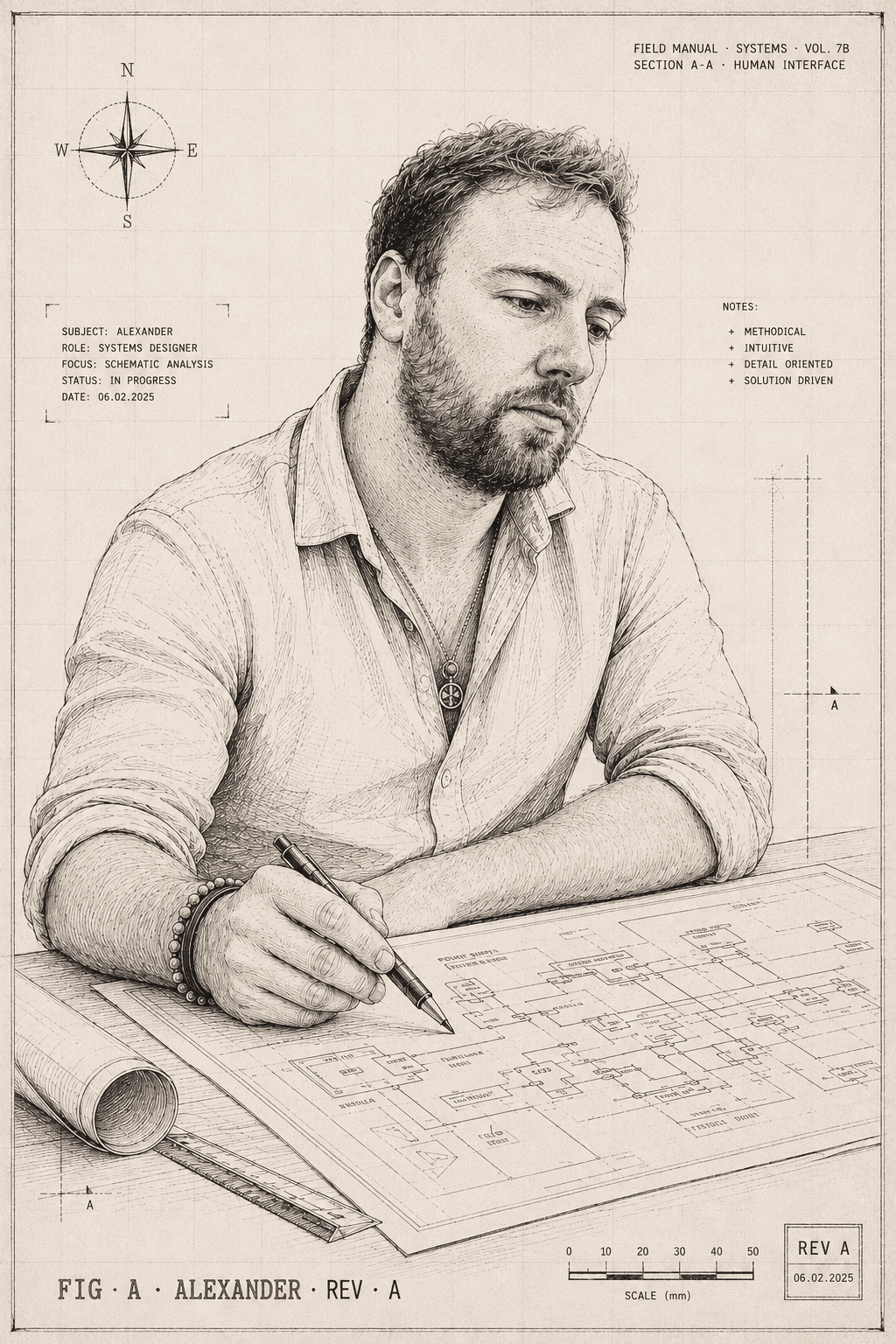
Drafting table at night — pen, scale ruler, compass, half-finished system diagram on vellum.
PL · 12 · A — DRAFTING BOARDREV · A

I’m Alexander Habiby. I failed out of computer science.

I was twenty. My academic advisor and I “mutually agreed” computer science wasn’t for me.

They were right academically. They were wrong professionally.

I’ve spent the last decade proving them wrong without fully believing it.

This cohort is what I would have paid anything for at twenty-four, when a tech startup was billing me to clients as a Heroku Technical Architect and I was googling “what is Heroku” at 2am.

I shipped that project. And every one after.

My CV
  • Currently the lead enterprise architect on two parallel Massachusetts statewide Salesforce/MuleSoft platforms.
  • Architected 60+ live enterprise systems across state and federal governments and private enterprise — many still in production today.
  • At technology consultancies MTX and Slalom, architects reported to me. I was responsible for best practices — what good architecture looked like across the firm, how new architects were trained, the standards we shipped against. Grew the licensing and grants vertical from $2M to $30M in two years, winning statewide systems in six states against Accenture and Deloitte.
  • Architected NYC’s COVID vaccine management systemand the public schools’ testing and contact tracing rollout — at the peak of the pandemic, when the city had to ship in weeks, not months.
Personal AI stack

In the last eight months, on my own machines, I built:

  • Personal MCP — a Supabase-backed vector store with five years of my journal, documents, emails, texts and my brain embedded, queryable from any AI client.
  • Hermes — a local agent that orchestrates everything from finance categorization to Notion sync.
  • A personal financial automation system that replaced Quicken, Rocket Money, YNAB, and files my taxes — saves me ~$200/month and got me an additional $30k in a tax refund.

Not because I had to. Because I wanted to own my tools instead of renting them.
13What I’m notPG · 13

I’m deliberately not the guy selling you Claude Code in 10 steps.

That genre is the education system’s worst habits wearing new clothes. Copy-paste tutorials that flatter you for two hours and leave you exactly where you started.

If that distinction doesn’t matter to you, this is the wrong cohort.

14 BonusesPG · 14
01

1:1 architecture intake

60–90 minutes with me before week 1. We see your setup, talk about what you want to build, and figure out how to get you moving fast in week 1.

02

Lifetime cohort access

You keep access to the cohort community space, recordings, and future curriculum updates. The system you build in week 8 is not the last system you’ll build.

03

Cohort-voted bonus week 9

Week 9 is a session voted on by the cohort. Whatever the room needs most.

15

$1,800. Once.

Cohort 01 price. Cohort 02 will be $2,500+. Pay in full, in three, or hold your seat with a $250 deposit. The price is the price. No upsell. No certification scheme. No Slack-tier nonsense.

Want to talk it through? Email me →

The ask

In exchange for the cohort 01 rate, you commit to a written testimonial after week 8 — if you got value.

Guarantee · 01
Three working systems or full refund.
Guarantee · 02
Architecture intake before the cohort starts.
Guarantee · 03
Weekly office hours for personalized assistance.

The full version: complete the nine weeks, submit the homework — if you don’t have three AI-native systems you built yourself and use daily, full refund.

16 FAQPG · 16

A few of the obvious ones.

Q · 01I’ve never written code. Am I in?+

If you’ve used Claude or ChatGPT daily for a few months, yes. The cohort isn’t about syntax. It’s about designing systems, then having the model write the code. We pair-build through week 1.

Q · 02I’m worried my situation is too unique.+

That’s what the 1:1 intake is for. 60–90 minutes before week 1 (and we won’t be rushed). We look at your actual setup, your actual stack, your actual list of someday-builds, and we pick a first-build path that fits you. Nobody walks in cold.

Q · 03Time commitment?+

Two 90-minute live calls per week + 3–6 hours of building. If you can’t protect 6–9 hours/week for 9 weeks, this is the wrong cohort. Wait for cohort 02 or follow my writing.

Q · 04What if I fall behind?+

Recordings posted within 24 hours. Async support in the community space. The cohort is small enough that you won’t get lost in it.

Q · 05What stack do you teach?+

Foundation Models (ChatGPT/Claude) that have autonomous coding agents. We let the AI drive the stack in collaboration with our real-world needs both effort-wise and cost. Built around tools you can audit and data you own — not lock-in. Model-agnostic by design.

Q · 06Why $1,800 when the next cohort is $2,500?+

Cohort 01 is smaller, scrappier, and gets more 1:1 from me. The testimonial commitment is the trade. After cohort 01 the price moves up and stays up.

Q · 07Will you teach me to build a SaaS?+

No. These are personal systems for your life. If you find a wedge that becomes a SaaS later, that’s yours.

Q · 08Why no application?+

I scrapped it. The application was a 48-hour speed bump in front of paying. The 1:1 architecture intake before week 1 is the real conversation, and the refund guarantee covers fit. If you want to talk before deciding, email me →. Otherwise hold your seat.

17

Build the thing you keep not building.

Fifteen of us are going to spend nine weeks building tools we own.

The seats close when the cohort fills, or July 14, whichever comes first.

Hold your seat →Or email me → if you want to talk it through first.